
Anthropologist Robin Dunbar famously suggested humans can comfortably maintain only about 150 stable relationships at once, yet most professionals meet far more people than that over the course of a career, leaving plenty of meaningful connections to quietly go cold simply from lack of a system to track them. Personal CRM apps have grown into a genuine category to solve exactly this problem, acting as an external memory for who’s in your life, when you last spoke, and what you talked about, distinct from a sales CRM built for closing deals rather than remembering people. The strongest apps in this space in 2026 differ mainly in how much they automate versus how much they ask a user to enter manually. Here’s a look at four of the leading options.
Dex
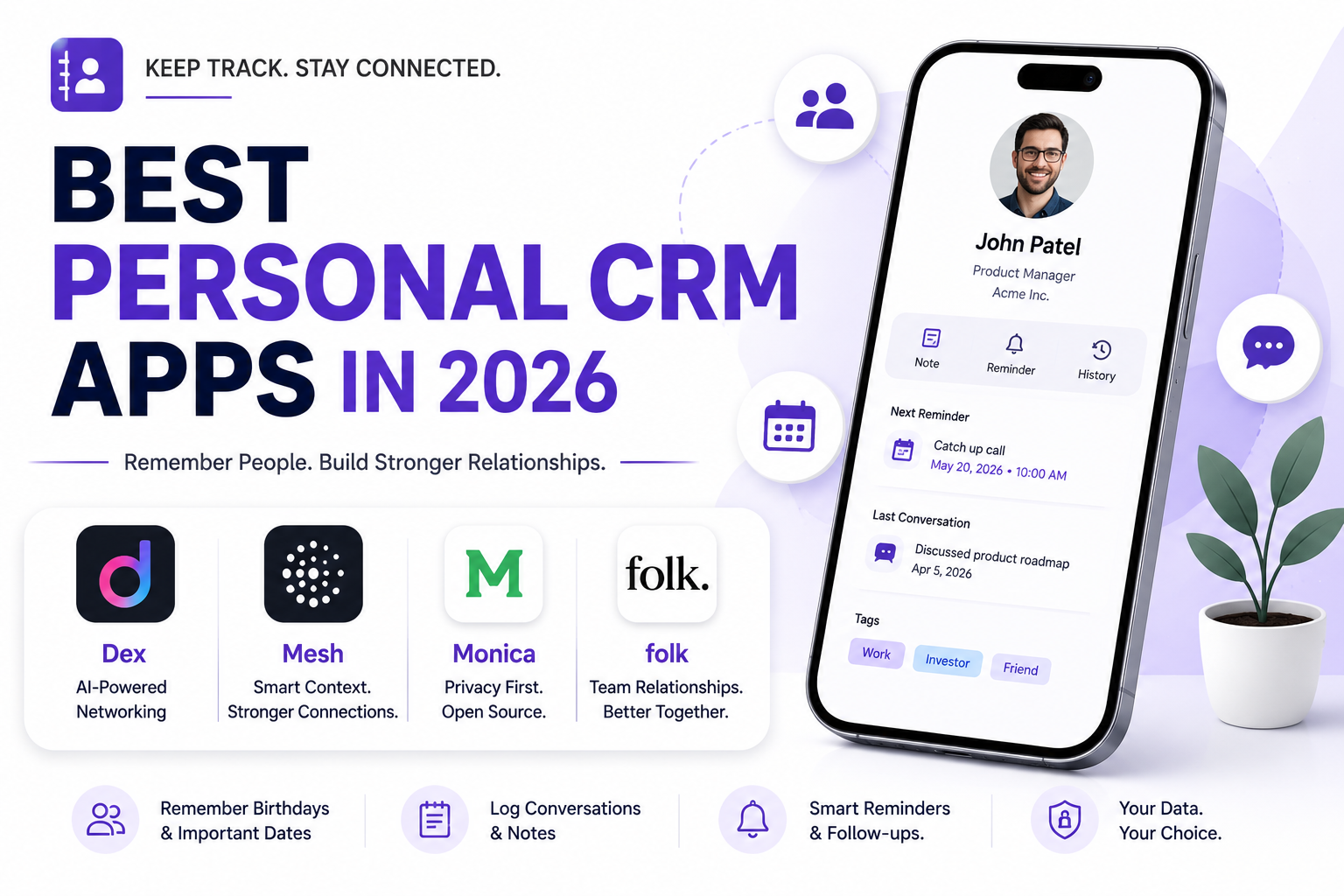
Dex has built its identity specifically around LinkedIn-heavy networkers, syncing automatically with a user’s LinkedIn connections and email to keep contact records current without much manual upkeep. Its Dex Copilot and AI Assist features handle reminders, add context ahead of an upcoming conversation, and can help draft a follow-up message, functioning as a genuine assistant rather than just a searchable database. The tradeoff is pricing: there’s no permanent free tier beyond a 7-day trial, positioning Dex as a tool for people who network seriously enough to justify an ongoing subscription rather than a casual contact list.
Mesh (formerly Clay)
Mesh, known as Clay until its acquisition by Automattic (the company behind WordPress) in mid-2025, remains the design benchmark for the category, with a distinctive dark-themed interface and the most complete conversation history of any personal CRM thanks to its iMessage and WhatsApp sync. Its AI-native contact enrichment automatically pulls in publicly available information about a contact, recent job changes, notable news mentions, giving useful context before a reconnection without requiring manual research. Its feature depth and $30-plus monthly pricing make it best suited to people managing a large network of high-value professional contacts rather than a general-purpose address book replacement.
Monica
Monica takes the opposite philosophy from Dex and Mesh, built as a fully open-source, privacy-first personal CRM with more than 24,000 GitHub stars, designed for documenting relationships in genuine personal detail rather than professional networking. It tracks birthdays, family members, food preferences, and gift ideas in a diary-like format, and the self-hosted version is completely free with no feature limits, though it requires a personal server and comes with zero automated data entry, no LinkedIn sync, no email integration, everything must be entered by hand. For privacy-conscious, technically comfortable users who prioritize data ownership over convenience, it remains the clearest option in the category.
folk
folk positions itself as the strongest option for small teams that need to manage relationships collaboratively rather than a single person tracking their own network alone, offering shared visibility, permissions, and workflows more typical of a lightweight sales CRM adapted for relationship management. Its import experience handles Gmail, LinkedIn, and CSV files particularly well, with strong deduplication that cuts down on the cleanup work usually required after a bulk contact import. For solo personal use it can feel somewhat over-built, but for founders, agencies, or small teams that need everyone working from the same relationship data, it remains one of the more capable collaborative options available.
The right choice among these four comes down mostly to two questions: how much automation is actually wanted, and whether the relationships being tracked are personal, professional, or a mix of both. Dex and Mesh both auto-sync from email and LinkedIn, trading a subscription cost for minimal manual upkeep, while Monica asks for full manual entry in exchange for complete data ownership and zero cost if self-hosted. Anyone managing relationships as part of a team rather than individually will get more direct value from folk’s shared, collaborative structure than from any of the single-user-focused alternatives.
Conclusion
A personal CRM only delivers value if it actually gets used consistently, and the honest advice across nearly every review of this category is the same: the best tool is the one whose reminders someone will still be following a year from now, not necessarily the one with the most features. Whether that means an automated, AI-assisted tool like Dex or Mesh, or a fully manual, privacy-first system like Monica, the underlying goal remains simple, making sure the people who matter don’t quietly slip away simply because no system was tracking them.