
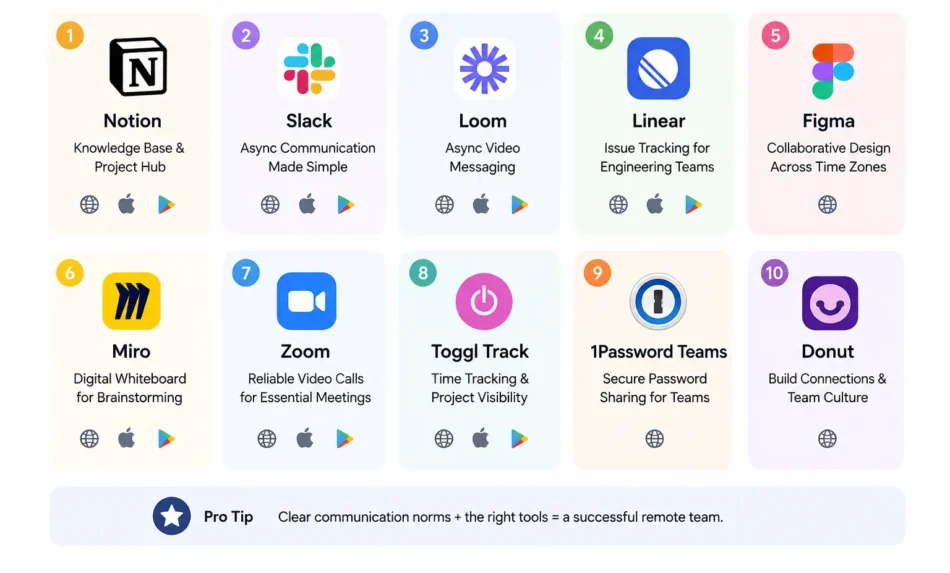

Remote teams in 2026 face a coordination challenge that physical offices solve passively – shared context, spontaneous communication, and the subtle social signals that keep distributed work aligned. The right app stack does not replicate the office but compensates for its absence with tools that are genuinely better for the asynchronous, documentation-driven, boundary-respecting way that healthy remote teams actually work. These ten apps form the most effective remote team toolkit available in 2026.
- Notion – Shared Knowledge Base and Project Hub
Notion serves as the single source of truth for distributed teams – project documentation, meeting notes, decision logs, onboarding materials, and team wikis all in a single searchable workspace accessible to every team member regardless of time zone or working hours.
Download on the Play Store or App Store.
- Slack – Async Communication Without Email Overload
Slack’s channel structure, AI summaries for catching up on missed conversations, and granular notification controls make it the best asynchronous team communication tool for remote teams managing multiple projects and conversations simultaneously.
Download on the Play Store or App Store.
- Loom – Replace Meetings with Async Video
Loom replaces thirty percent of synchronous meetings with asynchronous video explanations that viewers watch at their own pace and time zone. The AI transcription makes recordings searchable and the viewer analytics show whether important updates were actually consumed.
Download on the Play Store or App Store.
- Linear – Best Issue Tracking for Engineering Teams
Linear’s keyboard-first, minimal interface keeps issue tracking current without the overhead of heavier tools. For distributed engineering teams, accurate real-time project status in Linear reduces the need for synchronous status meetings and their associated scheduling complexity.
Download on the Play Store or App Store.
- Figma – Collaborative Design Across Time Zones
Figma’s real-time multi-user editing makes design review and iteration genuinely asynchronous – a designer can leave a file in review mode and engineers or product managers in another time zone can inspect specifications, leave comments, and continue work without any synchronous handoff.
- Miro – Best Digital Whiteboard for Remote Brainstorming
Miro’s infinite digital whiteboard supports sticky notes, flowcharts, user journey maps, retrospective boards, and free-form brainstorming in a format that works across both synchronous sessions and asynchronous contribution where team members add to boards on their own schedule.
Download on the Play Store or App Store.
- Zoom – Best Video Conferencing for Essential Sync Meetings
For the synchronous meetings that distributed teams cannot avoid – major decision points, team building sessions, and complex collaborative problem-solving – Zoom’s reliability, AI Companion features, and audio quality make it the best choice for essential real-time sessions.
Download on the Play Store or App Store.
- Toggl Track – Visibility Into Time Across the Team
Toggl Track provides project-level time tracking that is as important for remote team management as task completion tracking. Understanding how time is actually being spent across projects enables better planning, more accurate estimates, and clearer capacity conversations without surveillance implications that other time tracking approaches carry.
Download on the Play Store or App Store.
- 1Password Teams – Shared Credential Security
Remote teams accessing shared accounts and services need secure credential management that does not involve spreadsheets or Slack messages containing passwords. 1Password Teams provides encrypted shared vaults, fine-grained access controls per vault, and activity logs that maintain security compliance across distributed access.
- Donut – Best for Remote Team Culture
Donut integrates with Slack to randomly pair team members for virtual coffee chats on a configurable schedule, recreating the spontaneous cross-team relationship building that happens naturally in physical offices. Teams that use Donut consistently report stronger cross-functional relationships and better informal information flow than teams relying only on project-aligned communication.
The Most Important Remote Team Principle in 2026
Tools enable but do not create remote team culture. The most effective remote teams in 2026 share one characteristic beyond tool selection: a deliberate communication protocol that specifies what type of information goes where, what response time expectations apply to each channel, and what decisions require synchronous discussion versus asynchronous input. Document this protocol and revisit it quarterly. The tools are straightforward to select – the communication norms require ongoing intentional investment
